Sales Tax Basics
How Do You Calculate Sales Tax on Multiple Items?
- Shopping cart
- Tax calculation
- Exempt items
For a cart of items with the same tax treatment, add their taxable prices, multiply the subtotal by the rate, and add the tax to the cart total. If the cart contains exempt items or more than one rate, calculate each group separately. This guide shows each case with a worked example.
Table of Contents
- Carts With One Rate
- Carts With Exempt Items
- Items Taxed at Different Rates
- Discounts on the Whole Cart
- Per-Item vs. Invoice Rounding
- Keep an Itemized Receipt
- Frequently Asked Questions
- Final Thoughts
Carts With One Rate
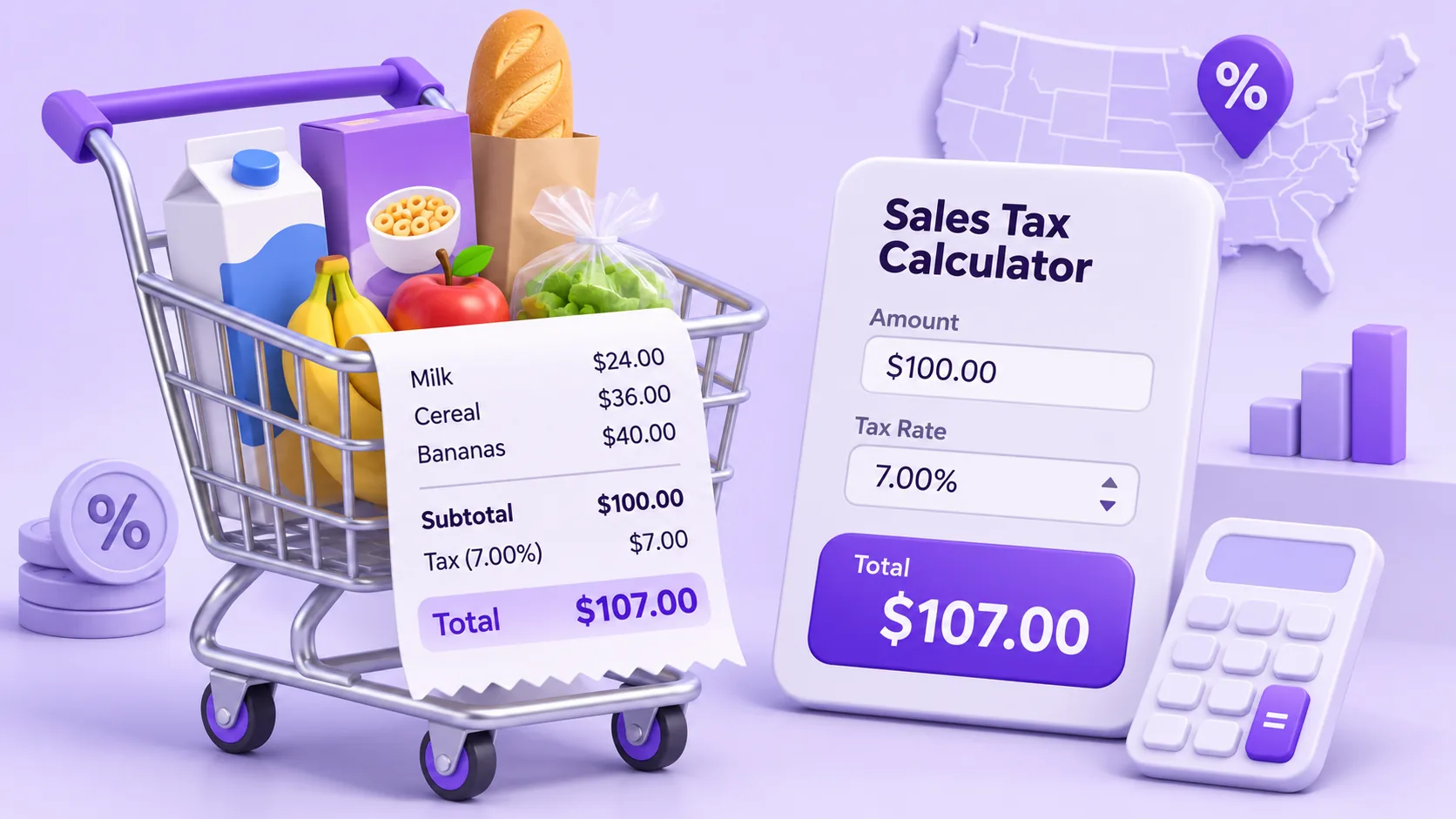
Suppose three taxable items cost $45, $30, and $25. Their taxable subtotal is $100. At an illustrative 7% rate, the tax is $100 × 0.07 = $7, so the total is $107.
Carts With Exempt Items
Now imagine the $25 item is exempt. Leave it out of the taxable subtotal, calculate the tax on the rest, then add it back to the total.
| Item | Price | Taxable? | Tax at 7% |
|---|---|---|---|
| Item A | $45.00 | Yes | $3.15 |
| Item B | $30.00 | Yes | $2.10 |
| Item C | $25.00 | No | $0.00 |
| Total | $100.00 | $5.25 |
The cart total is $100 + $5.25 = $105.25. This assumes no discounts, shipping, or other charges. Which items are exempt depends on the state.
Items Taxed at Different Rates
Some states tax certain items, such as groceries, at a reduced rate. Calculate each group separately and add the results. With $40 of items at an illustrative 7% and $20 of items at an illustrative 2%:
- $40 × 0.07 = $2.80
- $20 × 0.02 = $0.40
- Total tax: $3.20, for a cart total of $63.20
Discounts on the Whole Cart
When a coupon applies to the whole cart, many sellers spread it across the items in proportion to their prices. Take the $100 cart above, with $75 of taxable items and a $25 exempt item, and a 20% coupon. The taxable items drop to $60 and the exempt item to $20, so the tax is $60 × 0.07 = $4.20 and the total is $60 + $20 + $4.20 = $84.20. States have different rules for discounts, so check how yours treats them.
Per-Item vs. Invoice Rounding
Three items at $1.49 with an illustrative 8.25% rate show how rounding can change a total. Taxing each item gives $0.122925, rounded to $0.12, three times: $0.36. Taxing the $4.47 subtotal gives $0.368775, rounded to $0.37. Both methods are used, depending on the jurisdiction and the seller's system, which is why receipts can differ by a cent.
New York's taxable receipt bulletin explains identifying taxable and nontaxable items on an invoice. Businesses should follow their own jurisdiction's rules for discounts, bundles, and rounding.
Keep an Itemized Receipt
The Sales Tax Calculator is useful for each taxable subtotal. If you need to track individual sales, keep an itemized receipt and the rate source used on the transaction date.
Frequently Asked Questions
Do I add tax to each item or to the total?
If every item is taxed at the same rate, you can tax the subtotal. If some items are exempt or taxed at different rates, calculate each group separately.
What if one item in my cart is exempt?
Leave it out of the taxable subtotal, calculate tax on the remaining items, then add the exempt item back to the total.
How is a coupon for the whole cart handled?
Many sellers spread it across the items in proportion to their prices, which lowers the taxable amount. State rules differ.
Why is my total off by a cent?
The seller may round the tax on each item instead of on the subtotal, or the other way around.
Final Thoughts
For a mixed cart, group items by how they are taxed, calculate the tax for each group, and add everything together. Check discounts and rounding, and keep the itemized receipt if you need to account for the purchase later.
Enjoyed this post?
Share it with your network