Sales Tax Basics
What Is the Difference Between State and Local Sales Tax?
- State sales tax
- Local sales tax
- Sales tax rates
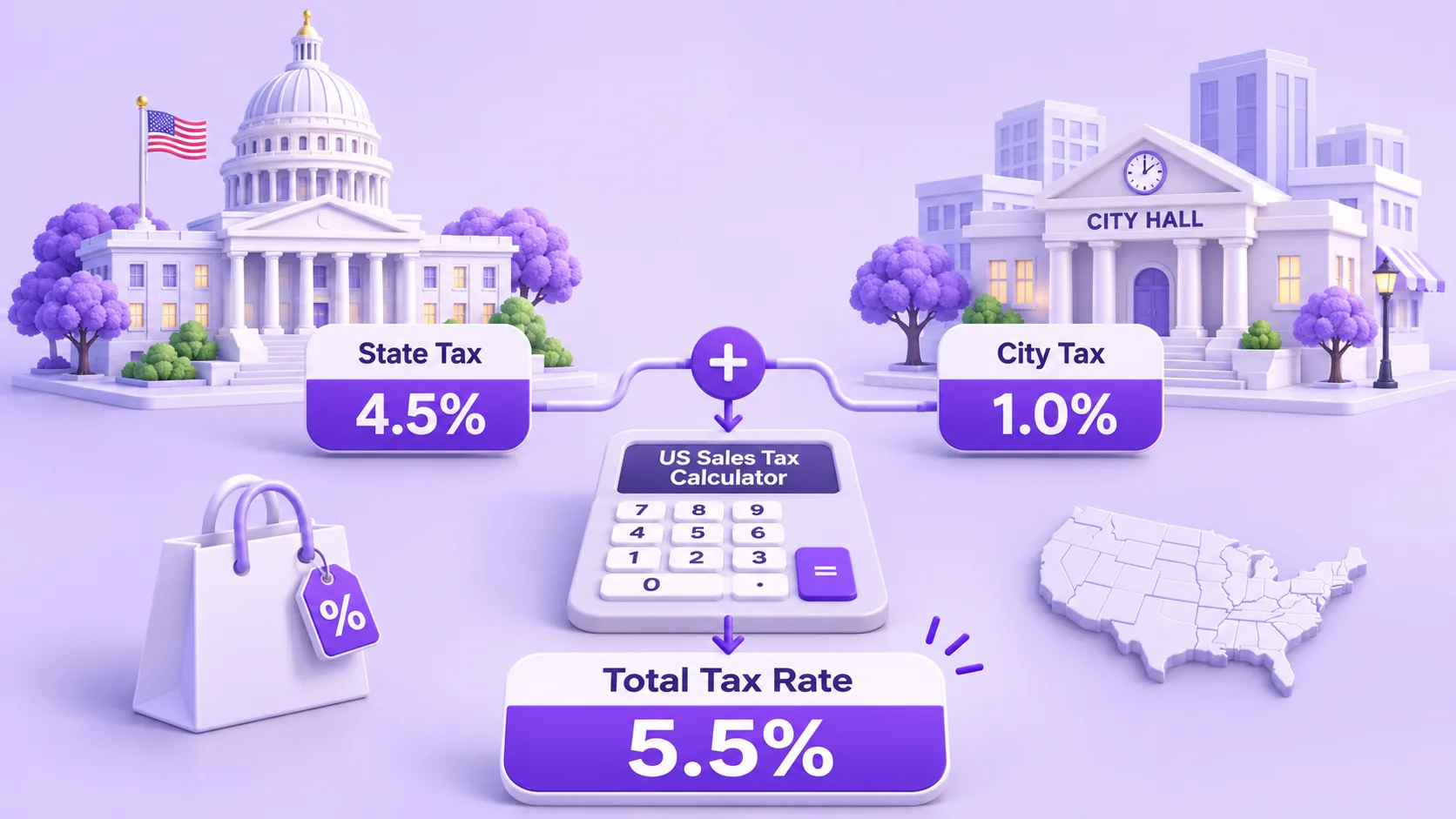
A state sales tax is imposed by a state. Local sales taxes may be imposed by a county, city, or special district where state law permits. Customers usually see one combined sales tax amount at checkout, even though the rate has several parts. This guide explains each part and how they add up.
Table of Contents
- What Is State Sales Tax?
- What Is Local Sales Tax?
- How the Rates Combine
- States Without Local Sales Taxes
- Why Nearby Addresses Can Differ
- How to Find the Combined Rate
- Frequently Asked Questions
- Final Thoughts
What Is State Sales Tax?
State sales tax is set by the state legislature and applies across the whole state. The state also decides which goods and services are taxable and which are exempt, and local taxes usually follow those rules. Statewide rates range from 2.90% in Colorado to 7.25% in California, and five states have none. See every state in our guide to sales tax rates by state.
What Is Local Sales Tax?
Where state law allows, counties, cities, and special districts can add their own sales tax. Special districts are often created to fund a specific purpose, such as public transit or emergency services. Each local tax applies only inside its own boundaries, so the local part of the rate depends on the exact address.
How the Rates Combine
The rate charged at checkout is the sum of every tax that applies at the location.
For example, the calculator's built-in data for Austin, TX (last checked September 21, 2026) breaks down like this:
| Tax | Rate |
|---|---|
| Texas state tax | 6.25% |
| City of Austin | 1.00% |
| Capital Metro transit | 1.00% |
| Combined rate | 8.25% |
A taxable $100 purchase there has $8.25 in sales tax. Only part of it goes to the state.
States Without Local Sales Taxes
In some states, no local sales taxes are added, so the statewide rate is the full rate everywhere: Connecticut, the District of Columbia, Indiana, Kentucky, Maine, Maryland, Massachusetts, Michigan, New Jersey, and Rhode Island.
Alaska is the opposite case. Alaska has no state sales tax, yet many municipalities impose a local sales tax.
Why Nearby Addresses Can Differ
Local tax boundaries do not always match postal ZIP codes. The place of delivery, product type, and effective date can matter too. Use an official address lookup for the jurisdiction rather than assuming that a statewide number is the checkout rate. Our ZIP code lookup guide explains why.
How to Find the Combined Rate
- Start with the statewide rate.
- Use the state's official address lookup to find every local tax at the exact address.
- Add the state and local rates together.
- Check the effective date, since local rates often change at the start of a quarter.
Once you have the combined rate, enter it in the Sales Tax Calculator to see the tax and total.
Frequently Asked Questions
Who sets local sales tax rates?
Counties, cities, and special districts set them, within the limits that state law allows, often with voter approval.
Do all states allow local sales taxes?
No. In Connecticut, Indiana, and Kentucky, for example, no local sales taxes are added to the statewide rate.
Why is the rate different in the next town?
Each city, county, or district can set its own local tax, so crossing a boundary can change the combined rate.
Do I pay local sales tax on online orders?
Often, yes. In most states, the tax on a shipped order is based on where it is delivered, including any local taxes there.
Final Thoughts
The rate at checkout is the state rate plus any local taxes for the address. Start with the state rate, add the local parts from an official lookup, and confirm the effective date. The Sales Tax Calculator shows how the total splits into state and local tax.
Enjoyed this post?
Share it with your network