UPC vs EAN vs Code128 vs QR: A Complete Guide to Choosing the Right Barcode for Your Business
Barcodes are essential tools for businesses to manage products, streamline operations, and improve accuracy in tracking inventory. However, with so many types of barcodes available — UPC, EAN, Code128, and QR — choosing the right one for your business can be confusing. In this guide, we’ll walk you through the key differences between these barcode types and help you decide which one suits your business needs the best.
Understanding the Different Types of Barcodes
1. UPC (Universal Product Code)
The UPC barcode is one of the most commonly used barcode formats, particularly in retail environments. It’s designed for easy tracking and management of retail products. The UPC code is typically 12 digits long and consists of a product identifier and manufacturer code.
Usage: Commonly used in the United States for retail products and groceries.
Advantages: Simple to scan, widely accepted, and ideal for retail transactions.
How to Generate UPC Code: You can easily generate UPC codes using a UPC barcode generator online. This tool allows you to create unique codes for every product in your inventory.
2. EAN (European Article Number)
The EAN code is similar to the UPC but is used internationally, especially outside the United States. The EAN number is 13 digits long and offers more flexibility for tracking products in global markets.
Usage: Commonly used across Europe and other regions around the world.
Advantages: Supports international business and product distribution. EAN codes help ensure compatibility in global retail markets.
How to Generate EAN Code: To generate EAN codes, you can use an online barcode generator that supports EAN format, allowing you to create codes for international products.
3. Code128
Code128 is a high-density barcode used in various industries such as shipping, logistics, and packaging. Unlike UPC and EAN, Code128 barcodes can encode both numeric and alphabetic characters, which makes them ideal for applications where more complex information needs to be encoded.
Usage: Often used in logistics, warehousing, and packaging.
Advantages: High data density, flexible encoding of alphanumeric characters, and used for applications that require more information.
How to Generate Code128: To generate Code128 barcodes, you can use a barcode design tool that supports this format, making it easy to track packages and products.
4. QR Code (Quick Response Code)
A QR code is a type of two-dimensional barcode that stores more information than traditional linear barcodes. It’s commonly used in marketing campaigns, payments, and mobile apps. QR codes can store data like URLs, contact details, and promotional offers, which can be easily scanned by a smartphone.
Usage: Common in digital marketing, mobile payments, and consumer-facing applications.
Advantages: Can store large amounts of data and is scannable with smartphones, making it ideal for customer engagement.
How to Generate QR Code: You can easily create QR codes using a QR code generator. These are often free and offer customization options for branding purposes.
Comparing Barcode Types for Your Business
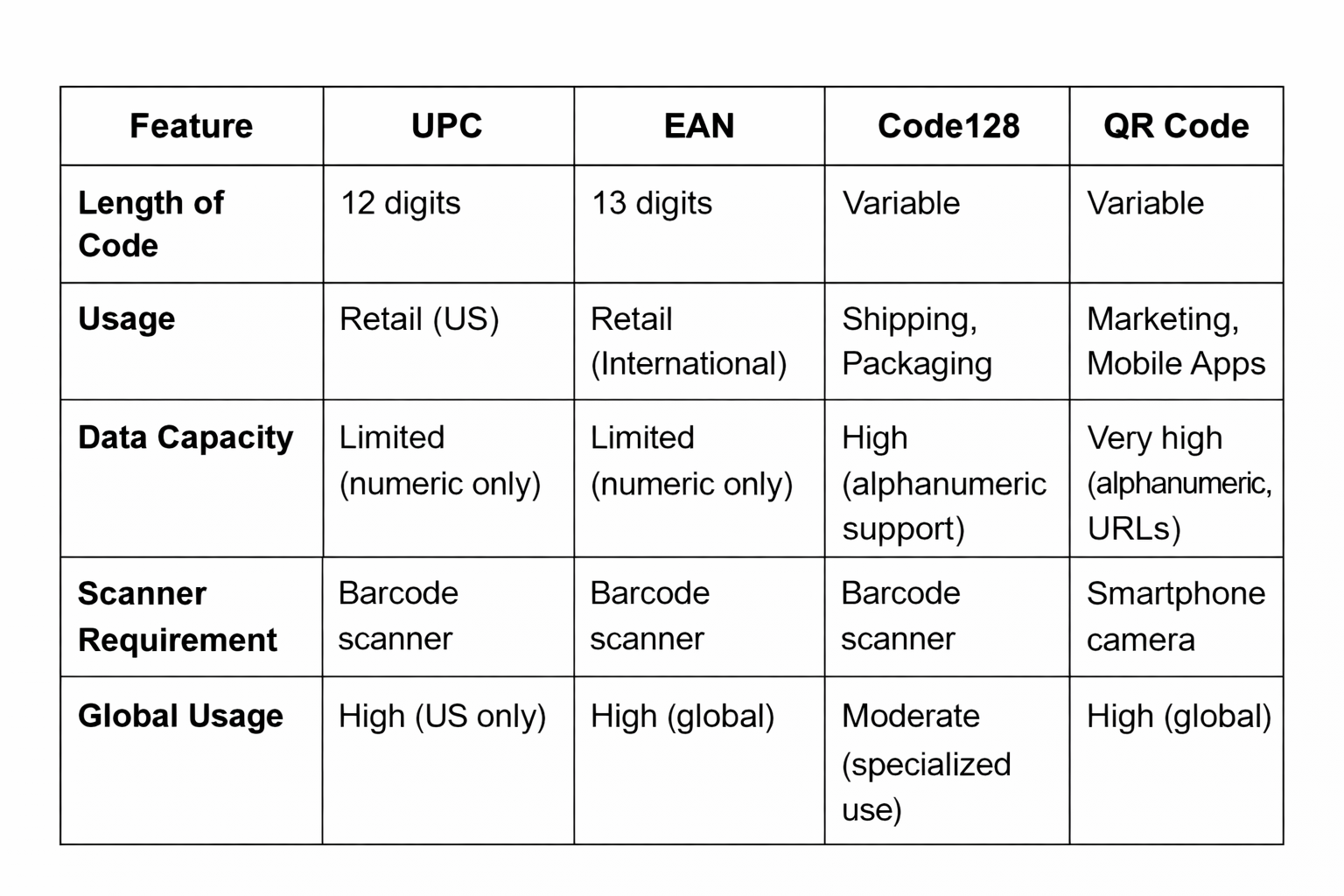
Here’s a quick comparison of UPC, EAN, Code128, and QR codes:
Which Barcode Type Should You Choose for Your Business?
If you're primarily operating in the US retail market, the UPC barcode is your best option. It’s the most widely accepted format for retail products in the United States.
If you’re doing international business, the EAN code will be more useful as it’s recognized worldwide, especially in Europe and other parts of the globe.
For shipping and logistics, the Code128 barcode is perfect. It’s designed to handle more complex and dense data, making it ideal for tracking goods in warehouses and shipping.
For marketing and consumer engagement, QR codes are highly effective. They are scannable with smartphones, can store various types of data (like URLs or promotional information), and are commonly used in advertising campaigns, event ticketing, and more.
How to Generate Barcodes:
To generate barcodes for your business, you don’t need expensive software or complicated systems. There are plenty of online barcode generators that allow you to easily create UPC, EAN, Code128, and even QR codes for your products, shipments, or marketing campaigns. These tools are quick, affordable, and allow for bulk barcode creation.
Conclusion
Choosing the right barcode type for your business can make a significant difference in streamlining your operations, improving accuracy, and enhancing customer experience. Knowing the differences between UPC, EAN, Code128, and QR codes is essential for selecting the most appropriate barcode format for your business needs.
For easy barcode generation, visit NewAgeApps.co and explore our powerful tools to create barcodes for any purpose. Whether you're handling inventory, shipping products, or connecting with customers, NewAgeApps offers the best solutions for all your barcode needs.
Enjoyed this post?
Share it with your network