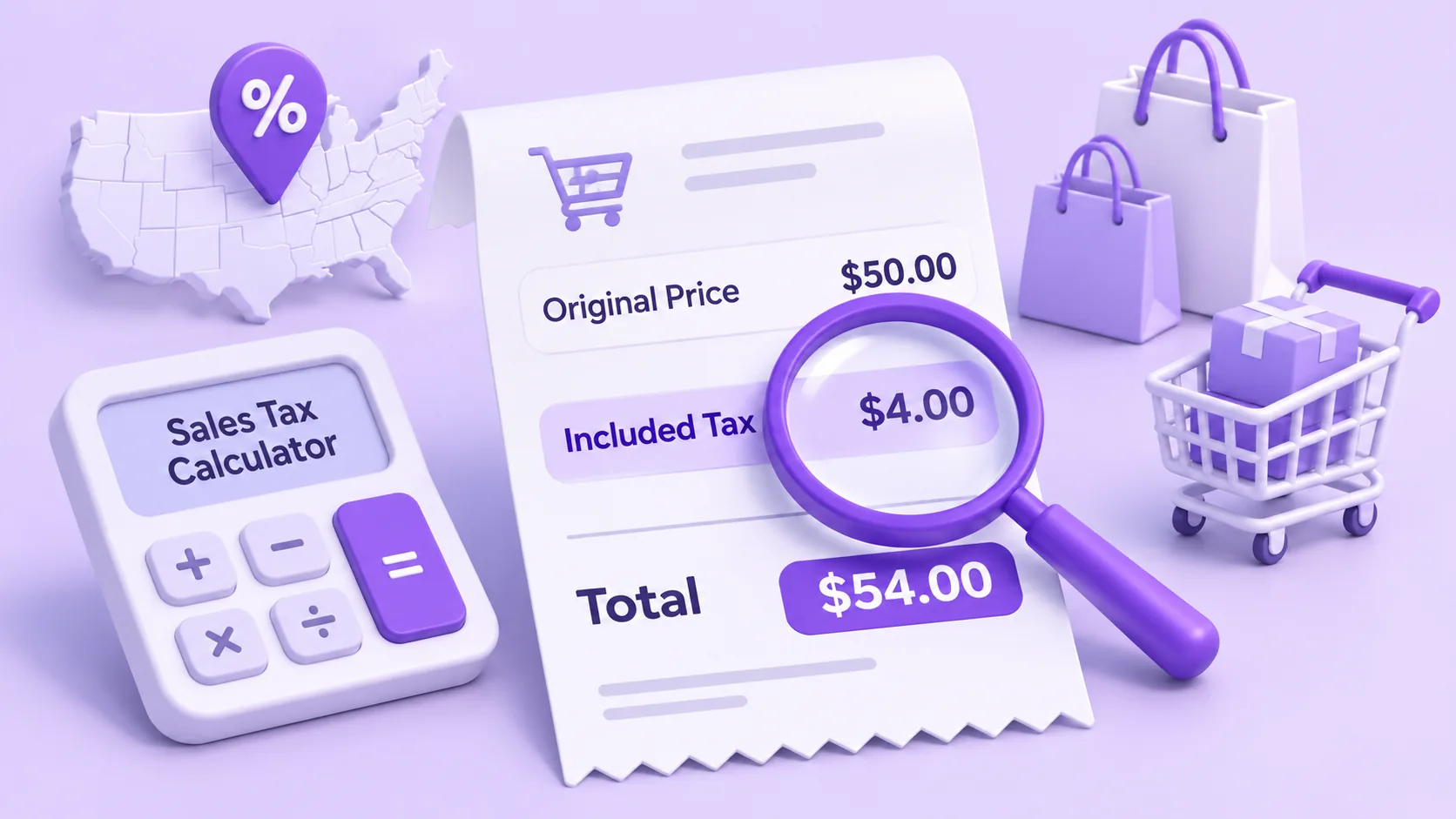
Sales Tax Basics
How Do You Calculate Sales Tax from a Total?
- Reverse sales tax
- Tax-inclusive price
- Receipts
A receipt may show the final amount paid without clearly separating the original selling price and the tax included. If you know the total and the applicable tax rate, you can estimate how much of that total represents sales tax.
Table of Contents
- What Information Do You Need?
- How to Separate Tax from a Total
- Example Calculation
- A One-Step Shortcut
- What If the Total Includes Other Charges?
- Check That the Total Includes Tax
- Frequently Asked Questions
- Final Thoughts
What Information Do You Need?
You need the tax-inclusive total and the applicable tax rate. If the total includes several items, different tax treatments, discounts, or other charges, you may need an itemized receipt for an accurate breakdown.
How to Separate Tax from a Total
- First, convert the tax rate to a decimal. Add 1 to the decimal rate, then divide the total by that number to estimate the pre-tax amount.
- Subtract the pre-tax amount from the total to find the tax portion.
Example Calculation
Assume a purchase total is $64.20 and includes tax at an assumed rate of 7%.
- Total including tax: $64.20
- Rate as a decimal: 0.07
- Pre-tax amount: $64.20 ÷ 1.07 = $60
- Included tax: $64.20 − $60 = $4.20
The estimated pre-tax amount is $60, and the included tax is $4.20.
A One-Step Shortcut
You can also find the tax directly: tax = total × rate ÷ (1 + rate). With the example above, $64.20 × 0.07 ÷ 1.07 = $4.20, the same result.
What If the Total Includes Other Charges?
If the total includes delivery fees, service charges, tips, or other non-tax amounts, you cannot always identify the tax correctly from the grand total alone. The taxability of each charge depends on the applicable jurisdiction.
Use an itemized receipt whenever possible, especially for business expenses or accounting records.
Check That the Total Includes Tax
Before you reverse a total, make sure it really includes sales tax. Many US prices are shown before tax, so reversing a pre-tax price would understate the original amount. Also allow for a difference of a cent when the original sale rounded tax on each item rather than on the total.
Frequently Asked Questions
Can I find the tax amount from the total alone?
Not reliably. You generally need the applicable tax rate and must know what charges are included in the total.
Is the tax simply the total multiplied by the tax rate?
No. When tax is already included in the total, use the reverse calculation method.
Can I use this for an expense report?
It can provide an estimate, but use the actual receipt or invoice for formal accounting wherever possible.
Final Thoughts
Separating tax from a total is useful for reviewing receipts and checking expenses. Use the correct rate and make sure the total contains no unrelated charges that could distort the calculation. Our backwards calculation guide explains the method in more detail, and the Sales Tax Calculator can reverse a total for you.
Enjoyed this post?
Share it with your network