Sales Tax Basics
How Do You Calculate Sales Tax on a Purchase?
- Sales tax calculator
- Tax calculation
- Sales tax formula
Knowing the sales tax before you reach the checkout helps you compare prices, plan a budget, and check a receipt. The math is simple once you have the taxable price and the right rate. This guide walks through the formula, a worked example, and the details that change the result, such as discounts, shipping, and rounding.
Table of Contents
- The Sales Tax Formula
- Step-by-Step Calculation
- Worked Example
- Quick Reference Table
- Discounts, Coupons, and Shipping
- Rounding to the Cent
- Frequently Asked Questions
- Final Thoughts
The Sales Tax Formula
The basic formula is:
- Sales tax = taxable price × tax rate
- Total = taxable price + sales tax, or in one step, total = taxable price × (1 + tax rate)
Convert the percentage to a decimal before multiplying by dividing it by 100. For example, 8% becomes 0.08 and 6.25% becomes 0.0625.
Step-by-Step Calculation
- Find the taxable price after any discounts that reduce it.
- Look up the combined sales tax rate for the location of the sale.
- Convert the rate to a decimal.
- Multiply the taxable price by the decimal rate to get the tax.
- Round the tax to the nearest cent.
- Add the tax to the price to get the total.
Worked Example
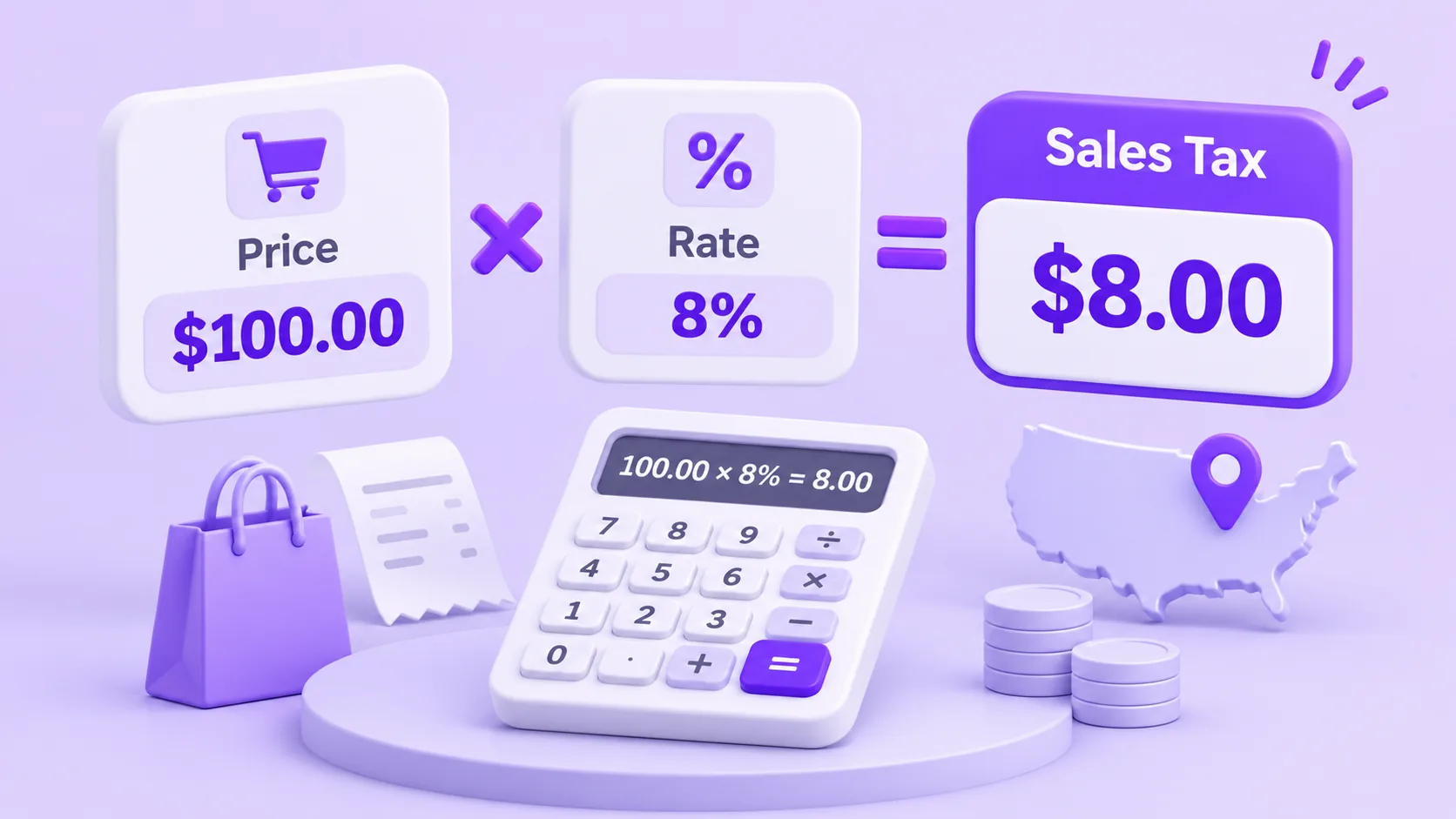
Suppose a taxable item costs $100 and the illustrative combined rate is 8%.
- Convert 8% to 0.08.
- Multiply $100 × 0.08 = $8.00.
- Add $100 + $8.00 = $108.00.
The sales tax is $8.00 and the total due is $108.00.
Quick Reference Table
At an illustrative rate of 7%:
| Price | Sales tax | Total |
|---|---|---|
| $10.00 | $0.70 | $10.70 |
| $25.00 | $1.75 | $26.75 |
| $75.00 | $5.25 | $80.25 |
| $250.00 | $17.50 | $267.50 |
Discounts, Coupons, and Shipping
A store discount usually reduces the taxable price, so tax is calculated on the lower amount. For example, an $80 item with a $10 store coupon has a taxable price of $70. At 8%, the tax is $70 × 0.08 = $5.60 and the total is $75.60.
Manufacturer coupons, rebates, and shipping charges are treated differently from state to state. Some states tax shipping and some do not, and some tax the price before a manufacturer coupon is applied. New York's taxable receipt guidance describes how taxable and nontaxable charges are identified on an invoice. Check the rules for your state before you multiply the whole cart by one rate.
Rounding to the Cent
Tax amounts often have more than two decimal places. A $19.99 item at 8.25% has a tax of $19.99 × 0.0825 = $1.649175, which rounds to $1.65, for a total of $21.64. Most sellers round to the nearest cent, but some calculate tax on each item and others on the invoice total, so a receipt can differ from your estimate by a cent.
Frequently Asked Questions
What is the formula for sales tax?
Multiply the taxable price by the tax rate written as a decimal. Add the result to the price to get the total.
How do I turn a percentage into a decimal?
Divide it by 100. For example, 7.5% becomes 0.075.
Is sales tax calculated before or after a discount?
A store discount usually lowers the taxable price, so tax is calculated after it. Manufacturer coupons can be treated differently, depending on the state.
Why doesn't my receipt match my calculation?
The seller may use a different rate for the location, treat some items as exempt, tax shipping, or round the tax on each item instead of the total.
Final Thoughts
To calculate sales tax, multiply the taxable price by the decimal rate and add the result to the price. Start from the right taxable amount and the right rate, and the rest is simple arithmetic. Enter both in the Sales Tax Calculator for a quick estimate, and see the multiple item guide for a mixed cart.
Enjoyed this post?
Share it with your network