Sales Tax Basics
What Is Sales Tax and How Does It Work?
- Sales tax basics
- State sales tax
- Use tax
Sales tax is a tax on certain retail sales. In places that impose it, the seller adds the tax to a taxable purchase at checkout, collects it from the customer, and pays it to the state or local tax authority. That is why the price on a shelf or product page is often lower than the amount you actually pay.
This guide explains what sales tax is, who sets the rate, what is usually taxed, and how it differs from use tax and VAT.
Table of Contents
- What Is Sales Tax?
- How Does Sales Tax Work?
- Who Sets the Sales Tax Rate?
- What Is Usually Taxed?
- A Quick Example
- Sales Tax vs. Use Tax
- Sales Tax vs. VAT
- Frequently Asked Questions
- Final Thoughts
What Is Sales Tax?
Sales tax is a consumption tax: it is charged when goods, and in some places services, are sold to the final customer. There is no national sales tax in the United States. Each state decides whether to impose one, which items are taxable, and what the rate is. Forty-five states and the District of Columbia have a statewide sales tax, and many of them allow cities, counties, and special districts to add their own.
In the US, sales tax is normally added on top of the listed price at checkout rather than included in it. A $25.00 price tag usually means $25.00 plus tax.
How Does Sales Tax Work?
Most sales tax systems follow the same basic steps:
- The seller registers with each state where it is required to collect tax.
- The seller decides what is taxable. Each item is checked against that state's rules, because some goods and services are exempt or taxed at a different rate.
- The seller finds the rate for the location that controls the sale, usually where the customer receives the item.
- The customer pays the price plus the tax at checkout, and the receipt shows the tax separately.
- The seller files and pays the collected tax to the tax authority on a regular schedule, such as monthly or quarterly.
The seller acts as a collector. The tax belongs to the state, so the seller must keep records of what was collected and pay it over on time.
Who Sets the Sales Tax Rate?
The rate you pay is often a combination of several taxes. The state sets a base rate, and local governments such as counties, cities, and transit or special districts may add their own. Together they make up the combined rate charged at checkout.
For example, New York's tax department explains that its combined rate includes state and local components and directs taxpayers to an address lookup. Because local taxes vary, two stores a few miles apart can charge different rates. Our guide to state and local sales tax shows how the parts fit together.
What Is Usually Taxed?
Rules differ from state to state, but some patterns are common. The table below is a general guide, not a rule for any particular state.
| Type of purchase | How it is often treated |
|---|---|
| General merchandise, such as furniture, electronics, and household goods | Taxable in states with a sales tax |
| Groceries | Exempt or taxed at a lower rate in many states |
| Prescription medicine | Exempt in most states |
| Clothing | Taxable in most states; exempt or partly exempt in a few |
| Restaurant meals and prepared food | Usually taxable |
| Services | Varies widely; many services are not taxed |
| Digital products and downloads | Varies widely by state |
Always check the specific item against the rules of the state where the sale takes place.
A Quick Example
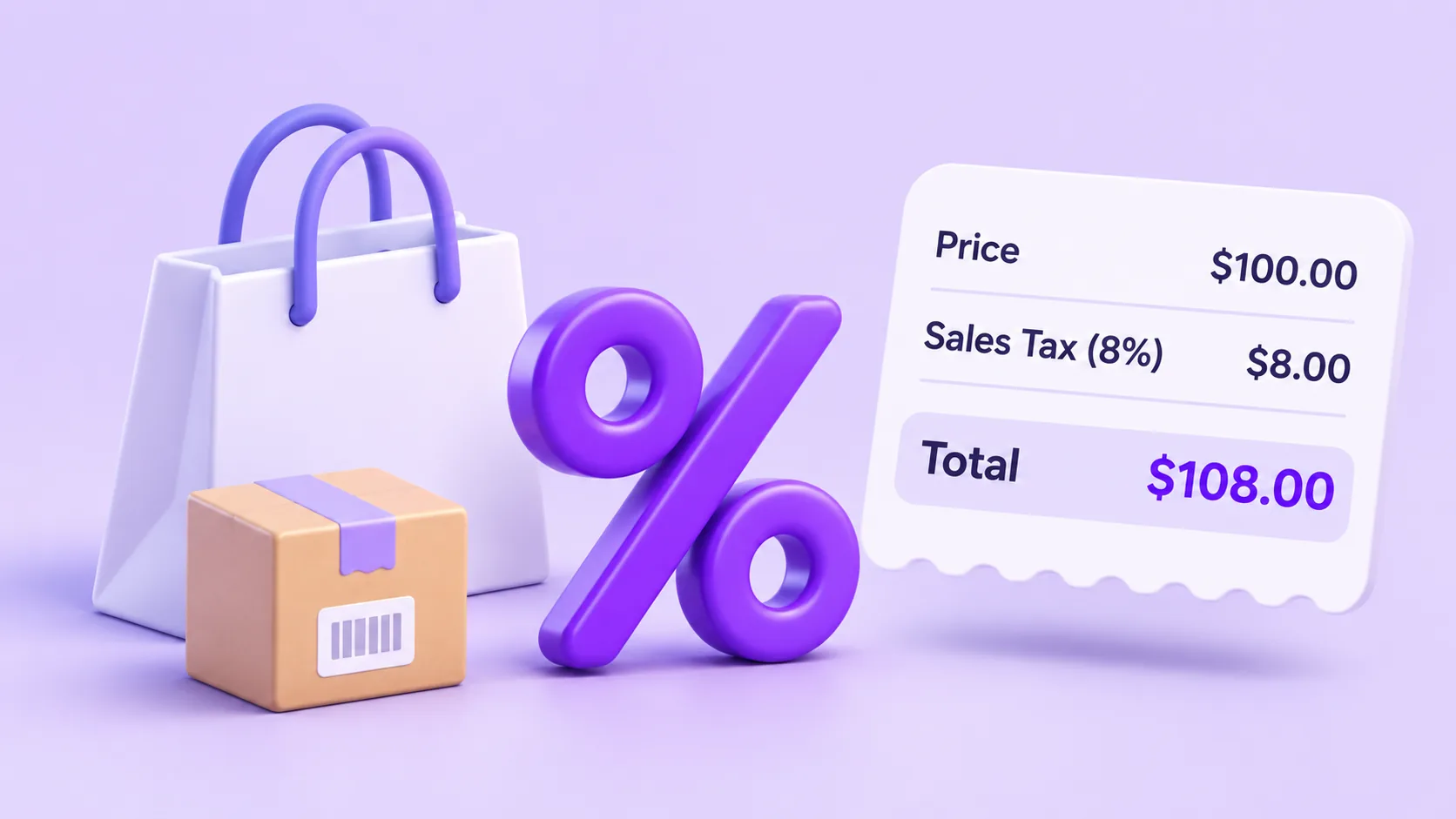
Suppose you buy a taxable item priced at $100 in a place with an illustrative combined rate of 8%.
- Sales tax: $100 × 0.08 = $8.00
- Total at checkout: $100 + $8.00 = $108.00
If the same item were exempt, the tax would be $0 and you would pay $100. The 8% rate is only an example; use the rate for the actual location. Our guide on calculating sales tax on a purchase covers discounts, shipping, and rounding.
Sales Tax vs. Use Tax
Use tax is the companion to sales tax. If you buy something taxable without paying sales tax, for example from a seller that was not required to collect it, your state may expect you to pay use tax on that purchase instead. The rate is generally the same as the sales tax you would have paid at home. Many states let individuals report use tax on their state income tax return.
Sales Tax vs. VAT
Many other countries use a value-added tax (VAT) or a goods and services tax (GST) instead of a sales tax. VAT is collected in stages along the supply chain, and shelf prices usually include it. US sales tax is generally collected once, on the final retail sale, and added at checkout. If you need to work with a VAT or GST rate, the Sales Tax Calculator can look up the rate for Canada, the United Kingdom, Australia, India, and the EU countries, and add or remove any rate you enter.
Frequently Asked Questions
Which states do not have a statewide sales tax?
Alaska, Delaware, Montana, New Hampshire, and Oregon do not have a general statewide sales tax. Some cities and boroughs in Alaska charge their own local sales tax.
Is sales tax the same everywhere in a state?
Not always. Many states allow local governments to add their own rates, so the combined rate can change from one city or county to the next.
Is sales tax included in the price I see?
In the US it usually is not. Listed prices normally exclude sales tax, and the tax is added at checkout.
Who pays sales tax to the state?
The seller collects the tax from the customer and pays it to the state. If tax was not collected on a taxable purchase, the buyer may owe use tax instead.
Final Thoughts
Sales tax is added at checkout, set by states and local governments, and depends on what you buy and where. To estimate the tax on a purchase, enter the price and a verified rate in the Sales Tax Calculator. For a real business transaction, check the rules of the state where the sale takes place.
Enjoyed this post?
Share it with your network